Fiber Cement & James Hardie Siding in Wilmington, NC
Wilmington Window & Siding Installation installs fiber cement siding for Wilmington, North Carolina homeowners researching a rigid, durable, paintable exterior cladding. Fiber cement is a cladding category made from cementitious and reinforcing components; James Hardie is a widely recognized manufacturer of fiber cement siding products within that category.
Homeowners consider fiber cement for its architectural appearance, dimensional stability, fire and rot resistance, and the range of lap, vertical, and accent profiles available. This page covers the benefits, the options, how fiber cement is installed, and what coastal North Carolina demands of the material — without claiming any manufacturer certification we have not verified.
Benefits of Fiber Cement Siding for Wilmington Homes
Fiber cement is a rigid material that mimics the look of milled wood while resisting the conditions that wear wood down on the coast — rot, insects, and fire. It holds paint far better than bare wood and offers a crisp, architectural appearance in lap, panel, and vertical profiles.
No material is maintenance-free or indestructible. Fiber cement still needs proper installation, correct clearances, and finish upkeep over time. The benefit is a durable, paintable exterior that holds up in humid, sun-exposed coastal conditions — not a lifetime guarantee. We frame it that way honestly.
Rigid & Dimensional
Fiber cement holds its shape across temperature swings, giving crisp, flat lap lines and stable vertical profiles without the buckling risk of poorly fastened vinyl.
Paintable Finish
Fiber cement accepts paint beautifully and holds it longer than bare wood. Factory finishes last longest; field finishes can be refreshed when the coating weathers.
Fire & Rot Resistance
Fiber cement resists fire, rot, and insects — properties that matter in humid coastal North Carolina where organic materials degrade faster.
Architectural Character
Lap, smooth and textured panels, shake, and vertical profiles let fiber cement suit traditional, craftsman, and modern coastal architecture alike.
Finish Maintenance
Unlike vinyl, fiber cement requires finish upkeep over time. The coating eventually needs refreshing — a planned maintenance cost, not a hidden surprise.
Proper Clearances
Fiber cement depends on correct clearances above grade and rooflines and proper flashing to manage moisture — details that determine its coastal longevity.
Interested in a fiber cement exterior? Discuss lap, vertical and accent siding options for your home.
Request an EstimateFiber Cement & James Hardie Siding Options Near Wilmington, NC
Fiber cement is produced in a range of profiles. Actual available colors, textures, and finishes depend on the product selected — we do not imply every style is always available for every project.
Horizontal Lap Siding
The most common fiber cement profile — overlapping boards that mimic traditional wood lap siding. Different exposures and smooth or wood-grain textures change the shadow line and character.
Board & Batten / Vertical
Vertical fiber cement creates a board and batten look with pronounced vertical lines popular for modern farmhouse and coastal designs. See our board and batten siding page.
Shake & Shingle Accents
Fiber cement shingle or shake profiles add texture to gables, dormers, or accent walls. They pair with lap siding for a layered, dimensional exterior.
Factory vs. Field Finish
Factory-finished fiber cement holds its coating longest and arrives ready to install; field-primed products are painted after installation and may need refreshing sooner. Finish choice affects both cost and maintenance timing.
Trim & Accessories
Fiber cement trim boards, corner boards, and frieze pieces complete the system. Where color and trim coordinate with soffit and fascia, see our soffit, fascia, and trim page.
Comparing materials? Fiber cement costs more and needs finish upkeep, while vinyl siding is lower-maintenance and less expensive but lower in impact resistance. We help you weigh both for your home rather than recommending one material for every exterior.
How Fiber Cement Siding Installation Works
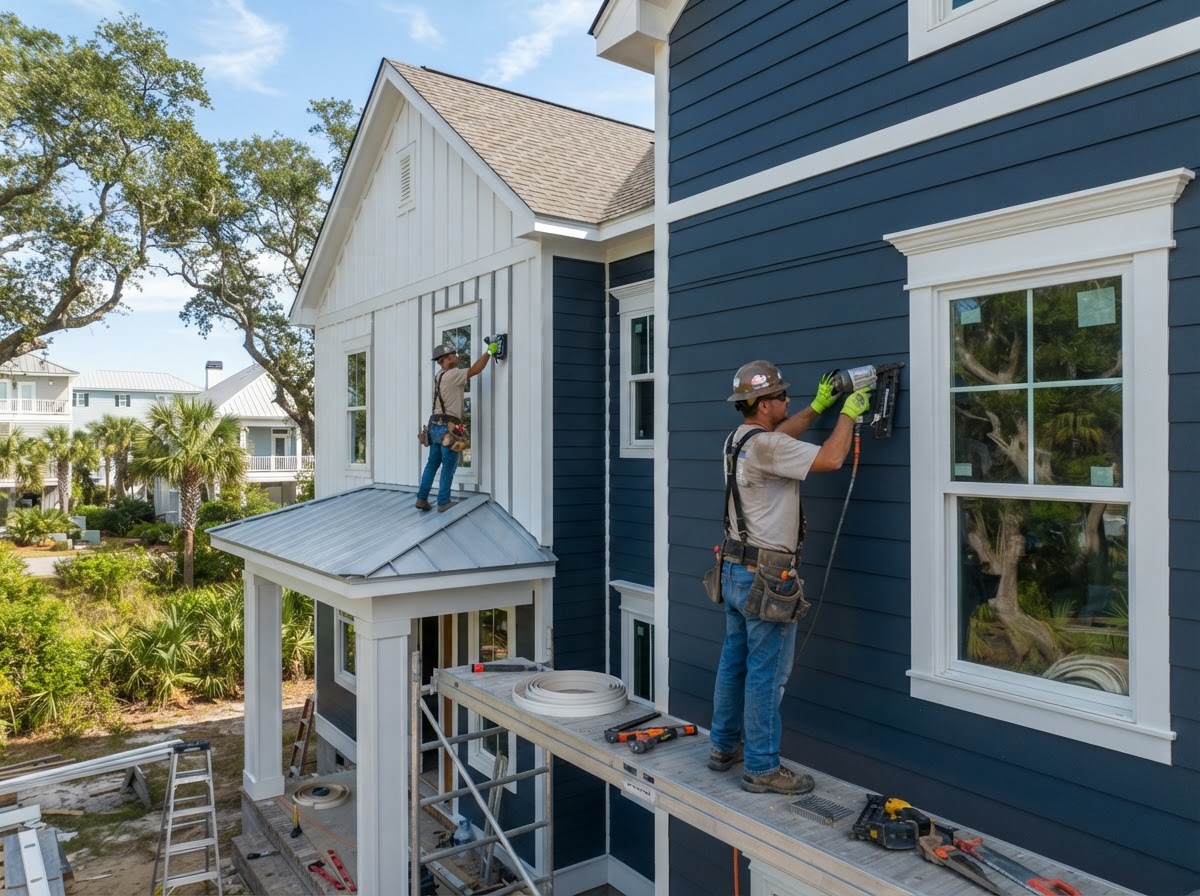
Fiber cement is less forgiving than vinyl when installed incorrectly, so the manufacturer's installation instructions matter. Clearances, fastening, flashing, and joint detailing all determine how the material performs in coastal wind and rain.
- 1Assess the exterior and plan material and layout.
- 2Remove existing siding where required and inspect the substrate.
- 3Install or repair the weather-resistive barrier and flashing.
- 4Establish correct clearances above grade and rooflines.
- 5Cut fiber cement per dust-handling guidelines.
- 6Fasten boards per the manufacturer's instructions.
- 7Address joints, corners, and trim details.
- 8Finish around windows and doors; review the appearance.
Moisture management is the determining factor for fiber cement's longevity. Proper clearances keep the bottom edge from wicking water, flashing at openings directs water out of the wall, and correct fastening prevents cracking from movement. We do not present unsupported technical specifications as universal requirements — product-specific instructions govern each installation.
Fiber Cement Siding for Wilmington's Coastal Environment
Fiber cement resists the rot, insects, and humidity that challenge organic materials on the coast, but rain, sun, storms, and salt air still shape how it should be installed and maintained.
Rain & Humidity
Proper flashing, clearances, and a sound weather-resistive barrier keep water out of the wall behind fiber cement in frequent coastal rain and high humidity.
Sun & Finish
Strong sun eventually weathers the paint or coating. Factory finishes hold longest; field-painted fiber cement may need refreshing sooner on exposed elevations.
Wind & Storms
Fiber cement's rigidity gives better impact resistance than vinyl, but it is not storm-proof. Correct fastening and flashing keep the wall intact in coastal winds.
Salt Air & Clearances
Salt air nearer the shoreline affects some finishes. Maintaining correct clearances and a sound coating protects the material where exposure is greatest.
Fiber cement is one option within a broader siding plan. For context on the full range of materials see our siding installation page, and for removing an existing exterior before installing fiber cement see siding replacement.
Fiber Cement & James Hardie Siding Wilmington NC FAQs
Direct answers about fiber cement siding and James Hardie products for Wilmington homes.
Considering Fiber Cement Siding in Wilmington, NC?
Let's discuss fiber cement profiles, finishes, clearances, and how the material fits your home's architecture and coastal exposure. Request an estimate or call our Wilmington team directly.